
Bunk Violette
Not a great headline but I've wasted enough time thinking about him (and Artforum) already. Plus a Super Bowl preview and the USA’s #1 song!
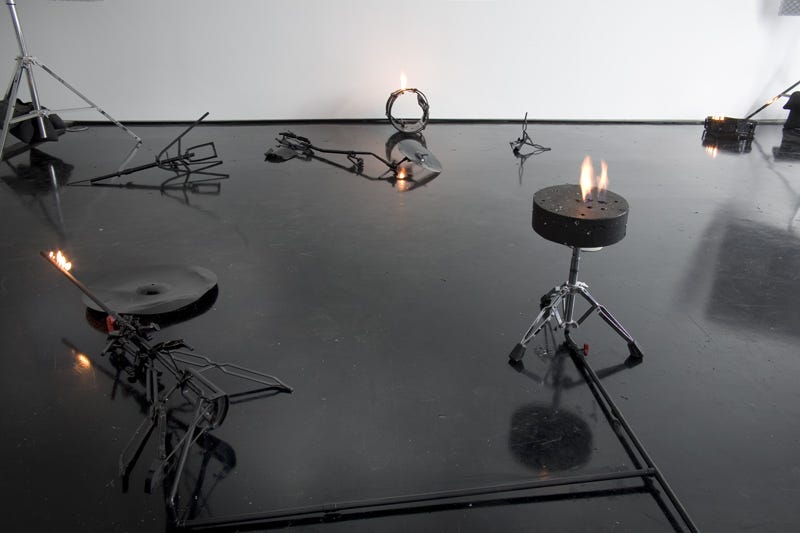
Aside from occasional impromptu toilet breaks at NYPL branches, I don’t look at Artforum. This week, however, I could not resist taking a peek—once again availing myself of library services—when I saw on social media that they had defiled themselves once again, in happily comic fashion, by putting Banks Violette on the magazine’s cover.
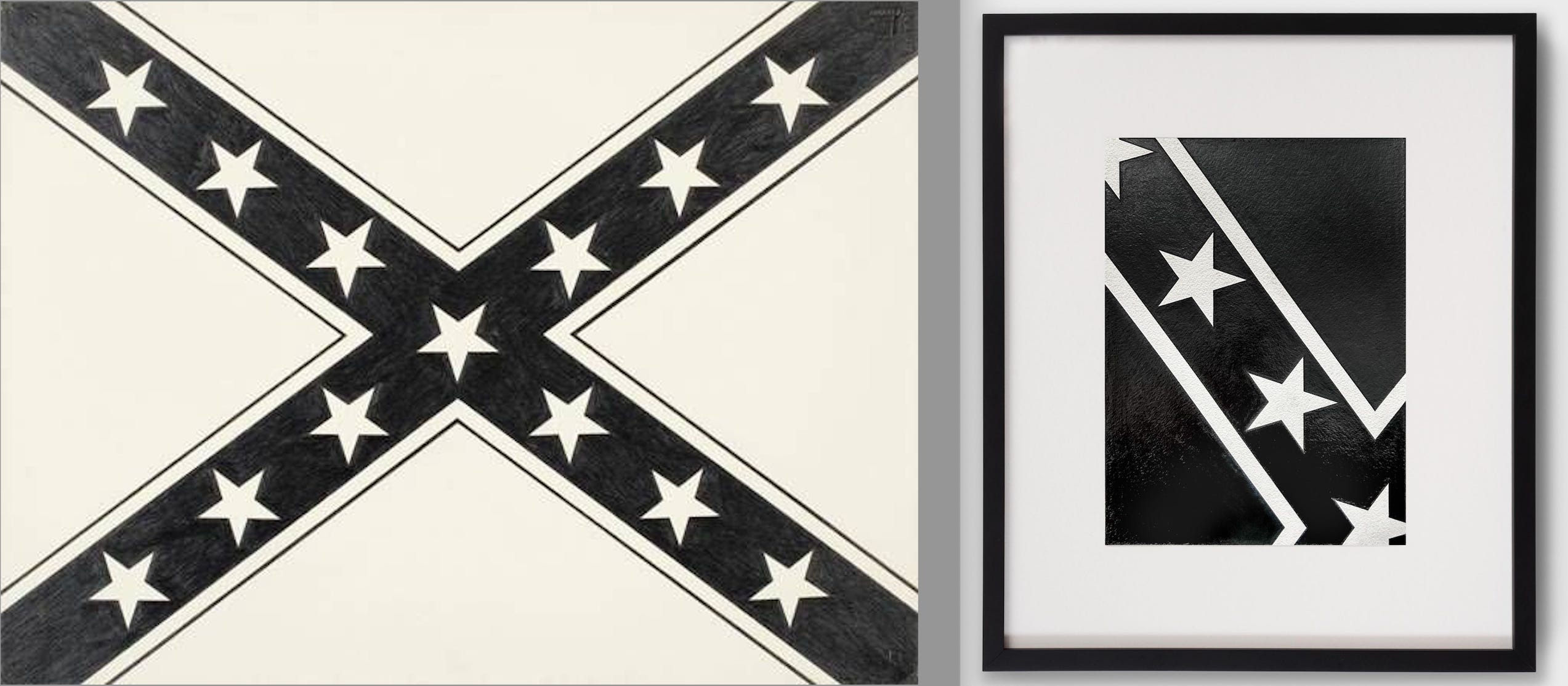
For those unfamiliar with the artist’s work, perhaps intrigued by his admittedly aces name: Do you like getting whacked in the face with a highly polished, ominously black plank of fiberglass as an expression of anomie? Do you love a monochrome palette, which, like the rest of the work, has failed to evolve over more than 20 years? Then you’ll love Banks Violette. You’ll presumably also love flaming drum kits, drawings of the Gadsden, Confederate, and American flags, cheap rip-offs of Jack Goldstein, smashed chandeliers as if designed by Dan Flavin, and that bouquet of flowers from that New Order album.
I have nothing personal against Violette. Bludgeoning art can occasionally hit the spot, if it’s funny or ramifies in ways that render it ultimately mysterious in the manner of great Pop art. But his oeuvre layers on melodrama like a vampire slathering on sunscreen. His none more black palette is worthy of Spinal Tap. His slick facture is supposed to be vapid? You don’t say. At least Dash Snow showed some interest in books.
Violette’s Artforum rehabilitation project was penned by the magazine’s executive editor, Rachel Wetzler. Given that she was one of the jackals who skulked into the campsite left behind when editors bolted after the firing of David Velasco—who was right about everything, need I remind you—I had assumed she was only ethically suspect. Apparently she is intellectually suspect as well. Her essay makes no real case for Violette’s quality as an artist, rather pinning its significance on its correspondence to its times, the A to B connecting of dots between “Iraq War” to “shiny black stalactites” and “MAGA” to “a pack of wild dogs.”
To be fair, Wetzler’s sentences aren’t bad, and she doesn’t do everything wrong. For example, she admits multiple times in the piece that astute observers back in the day found the work puerile and doesn’t attempt to rebut them. She accurately describes Violette’s work, such as his 2002 fiberglass unicorn with a melting face, as “heavy-handed.” She gives us a laugh by reminding us of some of his cornball peers, such as Gardar Eide Einarsson, Aïda Ruilova, Hanna Liden, Dash Snow, and last-among-equals Dan Colen. Also good for a chuckle is her leading with the girl-keep-that-to-yourself fact that she was first taken with the artist’s work as a teen.
The rhetorical move of making art a symptom of its times is always a crutch—what isn’t a symptom of its times? Why not write a cover story on the societal rot underpinning, say, the Terrifier franchise? But even I run through that number sometimes, so let’s play along: The essay is itself entirely symptomatic of its times, when sophistication has drained from criticism as its venues become fewer and fewer. It evinces no desire to make a critical judgement, let alone defend it. It roots its assessment in explicitly personal ground (try to step outside of yourself, and if not, at least be interesting). And it shows no recognition of its own logical inconsistencies, e.g., concluding that Violette’s exhibiting a head shot of Stormy Daniels in 2018 was bad (“a sophomoric shrug in the face of catastrophe”), but his depicting a close crop of the Confederate battle flag in 2025 is, to the contrary, good. The author does acknowledge Violette’s debts to Robert Smithson and Jack Goldstein (which some might call theft; see his renderings of fireworks that are actually exploding munitions and the numb deployment of German Shepherds) but omits his regurgitation of Cady Noland, whose work itself, I gotta say, has never actually tingled my spine.
The essay offers only a single, airy argument for his credibility as an artist, one that relies on the relative aptitude of his use of “strip-mined” symbols, as if he left them polysemic and did not burden them so crushingly with his own morbid sentiments. This results in the most embarrassing moment of the entire piece, a baldfaced account of Violette’s use of flags as evacuated signifiers without mentioning the art history 101 fact that Jasper Johns was onto this seventy years ago. Has Violette also discovered that you can drip paint onto a canvas instead of using a brush?

In this tack, the author follows Violette himself, who plays the same clumsy double game in a recent interview on the occasion of a current show in Brussels. Raggedly jump-cutting between the two ostensible yet contradictory logics for his work, he proclaims the significance of working with potentially open-ended symbols while at the same time admitting that he makes them a vehicle for his own passions:
I am not drawn to invention for its own sake, but to a single image that can hold multiple layers of meaning, like a flag, a horse, the end, the globe. Right now, I am trying to process the collapse we are witnessing. I experience it directly as an American citizen. . . . My response is rage, sorrow, grief.
So he chooses images that could have many meanings, only to use them to process his “rage, sorrow, and grief” in the most overt way. You can’t claim credit for the relative sophistication of the former attitude if you immediately negate it with the elementary approach of the latter.
The saddest thing about this whole misbegotten enterprise is that somewhere, some art student who knows nothing of the gutting of Artforum will read Wetzler’s essay, or the EIC’s even less reasonable introduction, and absorb it as wisdom, granting Violette a place in their understanding of art history. This is the ultimate cost of the magazine’s vitiation. If I could do any little thing with my writing, it would be to prevent the witless from brainwashing the impressionable into thinking people who suck are actually worth a damn.
Which is why it’s vital that you gift a paid subscription to Spigot to the young people in your life right away.
Super Bowl Preview
I know a lot of the sharp action at the moment is on Traitors (“Most people are familiar with Netflix and chill,” quoth BetUS, “but what about Netflix and some bets?”) and the African Spelling Bee (I’ve got the favorite, Nigeria, at +150), but this weekend why not turn your attention to the most irregular of sporting events, American football?
This year’s Super Bowl presents more of a puzzle than last year’s, about which I was, surprisingly, accurate. The contest between the Seattle Seahawks and the New England Patriots hinges, in my mind, on the performance of one historically volatile player, Seahawks QB Sam Darnold. Darnold has mostly looked excellent this year while occasionally faltering in ways that recall his history of spectacular flameouts, mostly famously with the New York Jets, where got the reputation of being a head case after being roasted during a live broadcast of a particularly bad performance for saying that he was “seeing ghosts” in the secondary. The NFL usually avoids embarrassing players with the sideline mics, so this was a conspicuously low blow, and Darnold’s grim fortune of being selected in the draft by one of the century’s most hapless sports franchises excuses anything that occurred while he was playing in the Meadowlands.
Now Darnold has rehabilitated himself in leading the Seahawks to the big game. The question is: Will he keep it together or will he lose his shit? I want to assume the former, which would all but assure a comfortable Seahawks win, but cannot rule out the latter. There aren’t a whole lot of other obvious variables in the game. The super annoying, cross-hugging, I married-my-middle-school-sweetheart (gross) Patriots QB Drake Maye will likely continue to start slow—he’s facing the league’s best defense—and gain momentum as the game goes along, but I’d be surprised if he emerged a singular hero. I do think Pats’ RB Rhamondre Stevenson, consistently underrated all year, will have a good game catching passes out of the backfield, so I’d take the over on his receiving yards. Bet on both QBs throwing at least one interception; bet on the Pats’ Milton Williams to get a sack.
As for the winner, I would take the Hawks if I had to choose outright (the Patriots plus 4 ½ is not a bad bet though). I’m guessing the game will be garish and chaotic, like a Doberman—a fucking tax-collector dog with proto-Nazi eugenicist vibes—winning the WKC Best in Show. Perhaps Banks Violette will start drawing Dobies to ensure his continuing relevance to our tragic times.
Music
This Sunday the musical delights do not stop at selections from Debí Tirar Más Fotos—or, if you’re turning the channel to Turning Points, Kid Rock’s proclamations of his ephebophilia—but also include everyone’s favorite jam, “The Star-Spangled Banner.” It’s fun to bet on the duration of the Super Bowl performance; this year’s over/under is currently 119 ½ seconds. Unfortunately there’s no reliable way whatsoever to predict the outcome: The performer, Charlie Puth, has never publicly sung a national anthem.
If you’ve heard of Puth, it’s probably thanks to Taylor Swift’s declaration that he “should be a bigger artist” on The Tortured Poets Department’s title track (right before the infamous “tattooed golden retriever” line). Frankly, he seems a little Canadian. See for example the wispy moustache, undershirt, and khakis (all just about as gross as the Drake Maye thing) in the only clue he’s offered us as to what might happen, a 2021 social media post of him dashing through an electric piano version of the national anthem in his own generic-ass home in a hot 62 seconds.
Thus the result on Sunday is anyone’s guess, and I prefer not to hear Puth’s voice until absolutely necessary, so I know nothing of his feelings toward melisma. This year, you might as well bet on the coin flip. Which, it turns out, favors tails by a margin of 54.2 to 46.8 percent. Take it to the bank!
What a relief to read lucid metacriticism. "The rhetorical move of making art a symptom of its times *is* always a crutch"—leads to facile art and judgment-less "criticism" that's not worth the effort required to keep one's focus on something so inane (mere ad copy, not an essay in the sense of "an attempt or effort").
Feel like the substance of this attack applies to (too) many artists