
Why I Wander
Getting lost and found with Nayland Blake at Art Omi. Plus Trader Joe's wine product, Philly ICA news, and Ween.

My lack of enthusiasm for upstate New York is well publicized. But if you haven’t been to Art Omi, located in the Hudson Valley town of Ghent, it’s pretty great. The sculpture park seeds its 120 acres with 60+ mostly large-scale artworks. Lots of famous and/or talented people are implicated, to impressive effect; Nayland Blake is currently the subject of an exhibition that appears in the on-site gallery space as well as outdoors.
But a visit to the place also offers up a subtler, sideways pleasure. One of the most serene aspects of viewing art for me is wayfinding: inscribing myriad dots on a mental map (or SeeSaw) and plotting routes between them. Is this what I’m supposed to be getting out of the artgoing experience? Perhaps not, though it’s probably the reason I got into art at all.
Places like Art Omi, or any number of cities periodically straddled by biennials, offer the bounded frisson of marking a course, wandering off it, getting lost, and finding one’s way again. As someone whose entire life has embodied this cycle, I find the experience fun, strangely comforting. (Reader, do not be shocked: I really am a journey-not-destination kind of guy.) When you get off track there’s much to discover; when you get back on track you remember once again that hope is viable and success, or at least arrival, is possible.
One of the most quietly miserable facets of the networked age is losing the ability to get lost, tossed like a soda can we were collectively too brusque even to crush before throwing it out the window, jettisoned in favor of the digital impetus toward coordinates and speed, which underpins the e-capitalist promise to get us whatever us want in an instant. But what if you don’t know what you want? What if none of us does? The move away from Freud (who, sure, has his problems) to a paradigm of mental action based upon neurochemicals and operant conditioning has convinced everyone that they are transparent to themselves, whereas I think that, except maybe for bodhisattvas and the like, it’s entirely the opposite case.
Blake’s show at Art Omi involves homebrewed mythology, charismatic cryptids, and a peculiar ’70s domesticity. Its most straightforward allusion is in fact to the 17th-century phenomenon of the ornamental hermit (well explicated at an event after the opening by Whitney Mallett), in which rich landowners would contract male adults to live in huts on their estates in rustic style, oft sans trimming hair or nails. These human pets, a kind of scenic livestock, provided nostalgic connotations of simpler times and general amusement when encountered on the occasional foxhunt or ramble. Blake’s commentary on the role of the artist vis-à-vis patrons is duly noted.
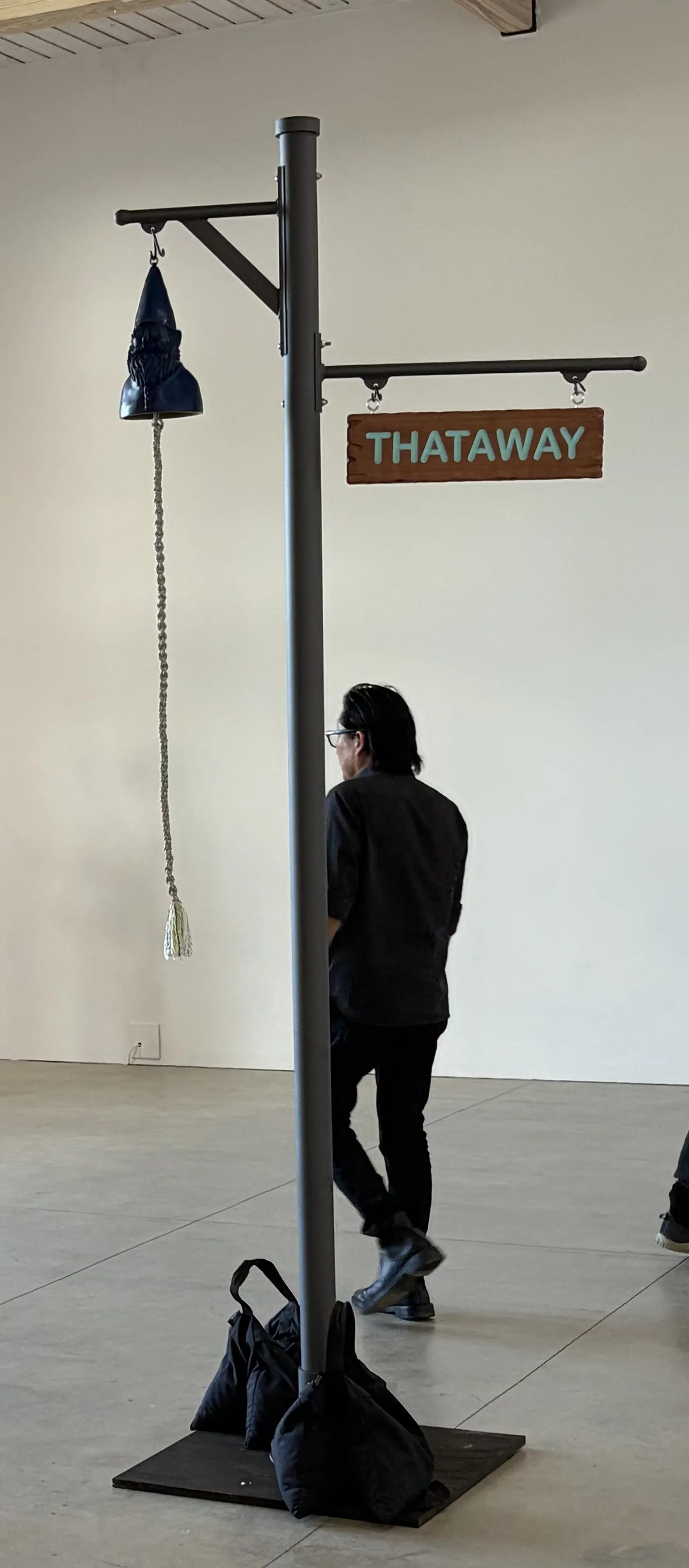
The strand of the exhibition I most fixated on, however, was its nod toward finding one’s way. Most literally this impetus took the form of directional signs sprinkled around the campus, including one plunked in the middle of the gallery space, that point THATAWAY and feature bells that one might ring to signal the lost, or if lost oneself. (These take the shape of garden gnomes, which apparently are the less disturbing form the ornamental hermit evolved into.) Blake’s presentation is crucially titled “Haunt,” with quotation marks as gaga as those around Emerald Fennell’s “Wuthering Heights.” The exhibition is built around another persona more important to the artist, an alter ego named Victorya Spectre, a campy ghost of Times Square past, the mythological era of porn-theater hookups (nostalgia not being limited to the elite) that was immortalized in Samuel Delany’s Times Square Red, Times Square Blue (1999).
The Omi incarnation of Spectre takes the form of a cloaked figure with a pink-eyed mouse-like mien. (A “cryptid appearance” had been scheduled for 3 pm on opening day, but alas, I arrived too late.) In the gallery, we get glimpses of them in a deliberately grainy slideslow—shot by Sam Penn—on an honest-to-god analog slide projector. The creature/character, which/who for some reason reminded me of the ever-increasing tendency of humans to identify themselves with beastly avatars, bears a staff strung with jangling objects including a tin cup, a whisk broom, a stuffed animal, and an orange ribbon that upon closer examination appeared to be a leash.
The loss of passion for cryptids like the Loch Ness Monster, the Yeti, and so on, which has been accompanied by a shift of psychic energy to spirits and other more ethereal entities, is a corollary of the impossibility of getting lost. If the ground under your feet is always gridded, and every object is chipped, there’s no place for an organic beast to lurk. But don’t worry, we can still wild our imaginations by believing that spirits are out there, and aliens to boot. (We can also dress up as furries.) We just can’t detect them with our primitive technologies. It still seems as if ghosts can only detected with the human instrument, and aliens only make their presence known when they choose to reveal themselves or their machinery busts a gasket, even as they manage to elude strict documentation.
Blake’s affinity with the cute and fuzzy goes back quite a ways, to some of their earliest work in the 1990s, when they first made a kind of avatar out of the bunny rabbit. At that point the artist used bunnies as a multiplicitous cypher, perhaps most famously in the video Negative Bunny (1994), which features a sexually desperate—and, if you ask them, HIV-negative—plush red rabbit. But in Blake’s hands the rabbit also stands in for other markers of identity. In 2000, you see the artist themself, who is biracial, donning a weighted bunny suit and attempting to tap-dance to a playlist of Michael Jackson in the video Starting Over. Blake’s figuring of the queer, the Black, the thicc, the otherwise otherized all in the same character emphasizes an inbetweenness or indeterminacy that’s radically scarce in a world defined by definition, not merely as decreed by social hegemons but also by the unrelenting specificity of 0s and 1s: the grid. Blake’s refusal to be pinned down, paired with their sharp sense of humor, a real political consciousness, and an affinity for the homey or even kitsch, makes for an altogether unusual, indeed unique practice.
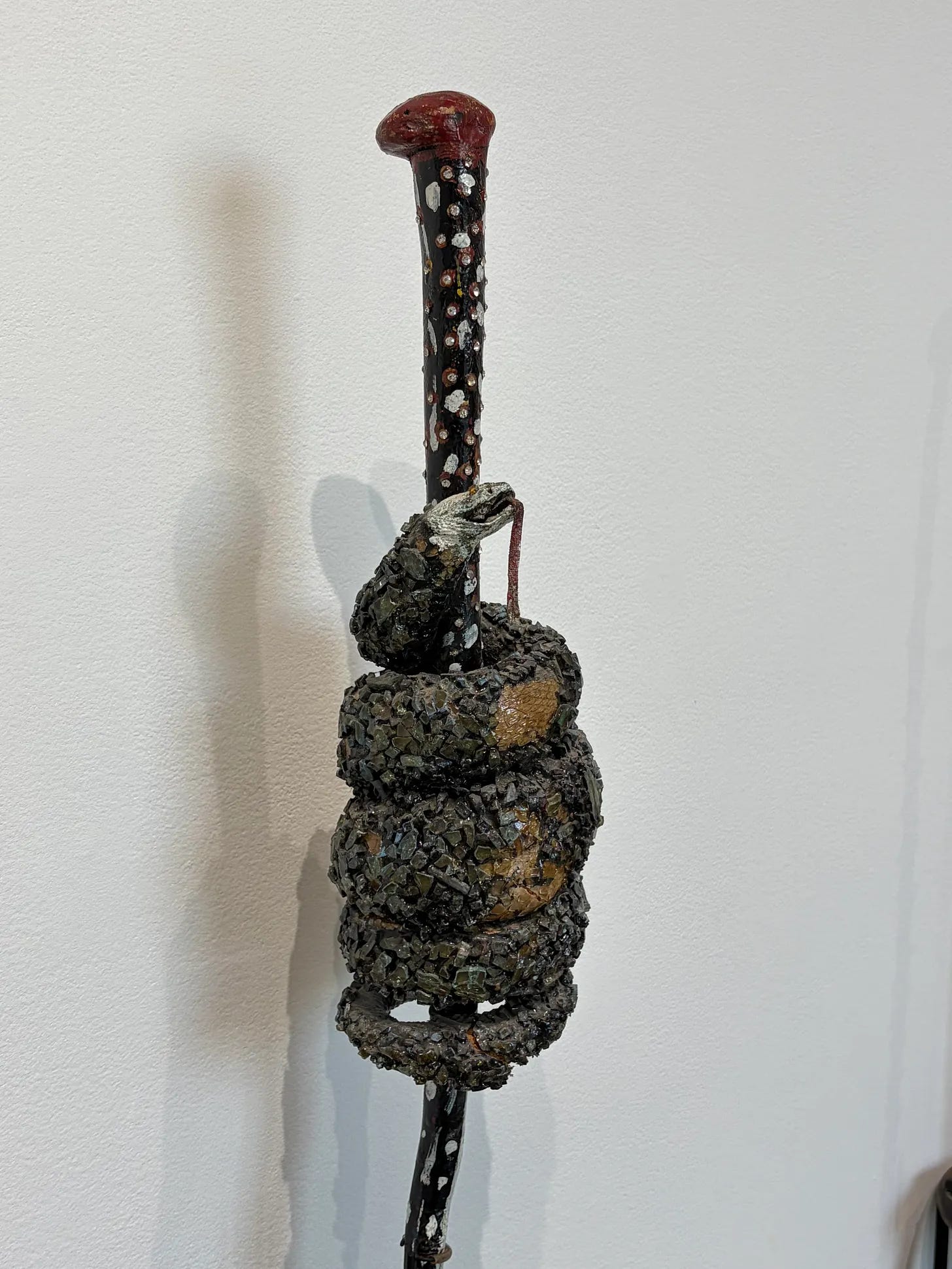
Coiling around Haunt are yet further layers of meaning. In the gallery space, a walking staff with a snake curled around it recalls the Rod of Asclepius, which is traditionally a symbol of medicine and the healing arts. It’s often confused with the two-serpent Staff of Caduceus, associated with the quick-tongued messenger god Mercury, alchemy, and deception, most likely because of a screw-up in the US Army’s choice of symbol for its medical corps in 1902. Blake’s gives us their version of a Caduceus and Rod side by side, with the conflation of the two no doubt intentional, given the well-meaning mischief common to the artist’s creations and Blake themselves.
At the same time, the paired snakes conjure a different Greek: the prophet Tiresias, who is turned into a woman for seven years when he interrupts two snakes in flagrante delicto. Multiple tales surround Tiresias, but the one Blake focuses on is the one that explains how they became both a prophet and lost their sight, struck blind for giving the wrong answer when asked by a couple of quarreling gods who had more pleasure in sex, men or women. (Fun fact: It’s women.) In return, Tiresias is given the gift of prophecy; and so with the hewn staffs, Blake imbues their timeless, shadowy, fugitive, ambiguous, rodentine presence with a secret, some knowledge to pass on in a whisper if one waits patiently in the dark. The woods-wandering seeker, implicitly otherized, is offered direction from a source altogether different from the satellite map on your phone—an elder who knows the wisdom of taking paths off the straight and narrow or a fellow traveler to hold hands with in the dark.
Music
Sara O’Keeffe, Art Omi’s senior curator, deserves two congrats: Not only did she organize Blake’s “Haunt”; she also scored a new job as DAJ Director and Curator of Public Engagement and Research at Philadelphia’s Institute for Contemporary Art.
There’s no greater orientation to the city than Ween’s “Freedom of ’76,” a tune as sweet as Schuylkill sunshine. A relic of a more innocent time, the video features the duo heisting the Liberty Bell (in the name of freedom, obviously, as declared by their armbands), being apprehended by a Blues Brothers–size battalion of police, appearing in court, and exiting to crowds as fervant as those that will receive Luigi Mangione at 100 Centre Street beginning this fall.
Good luck Sara! May you never need to slide a lockpick between your cheek and gum.
Wine
Whenever I go into a Trader Joe’s I feel like I accidentally bought a ticket to an amusement park. The employees all seem artificially happy, like management is pumping nitrous in with the AC. Yes, I’m glad people have tolerable jobs (if they do; see below), and that not all grocery stores are generic sheet-metal sheds, and the only gummy candy I’ll eat is Scandinavian Swimmers. On the other hand, Hawaiian shirts should be left with the Boogaloo Boys on the ashheap of history.
One redoubt of old-days Trader Joe’s, when the only way an East Coaster could taste its pixie dust was to fly to California, was what was known as “two-buck Chuck,” a commensurately corny name for some dirt-priced red wine. I’m not a student of the TJ’s lore, so I don’t know when the cost eclipsed a Jefferson or when the concept was abandoned. In New York, you could never buy wine in a Trader Joe’s per se, thanks to the state’s silly liquor laws, though the company did operate a vinaio for a number of years on 14th Street. It closed in 2022, in a move alleged in an NLRB complaint by employees and union officials to be part of an anti-labor effort.
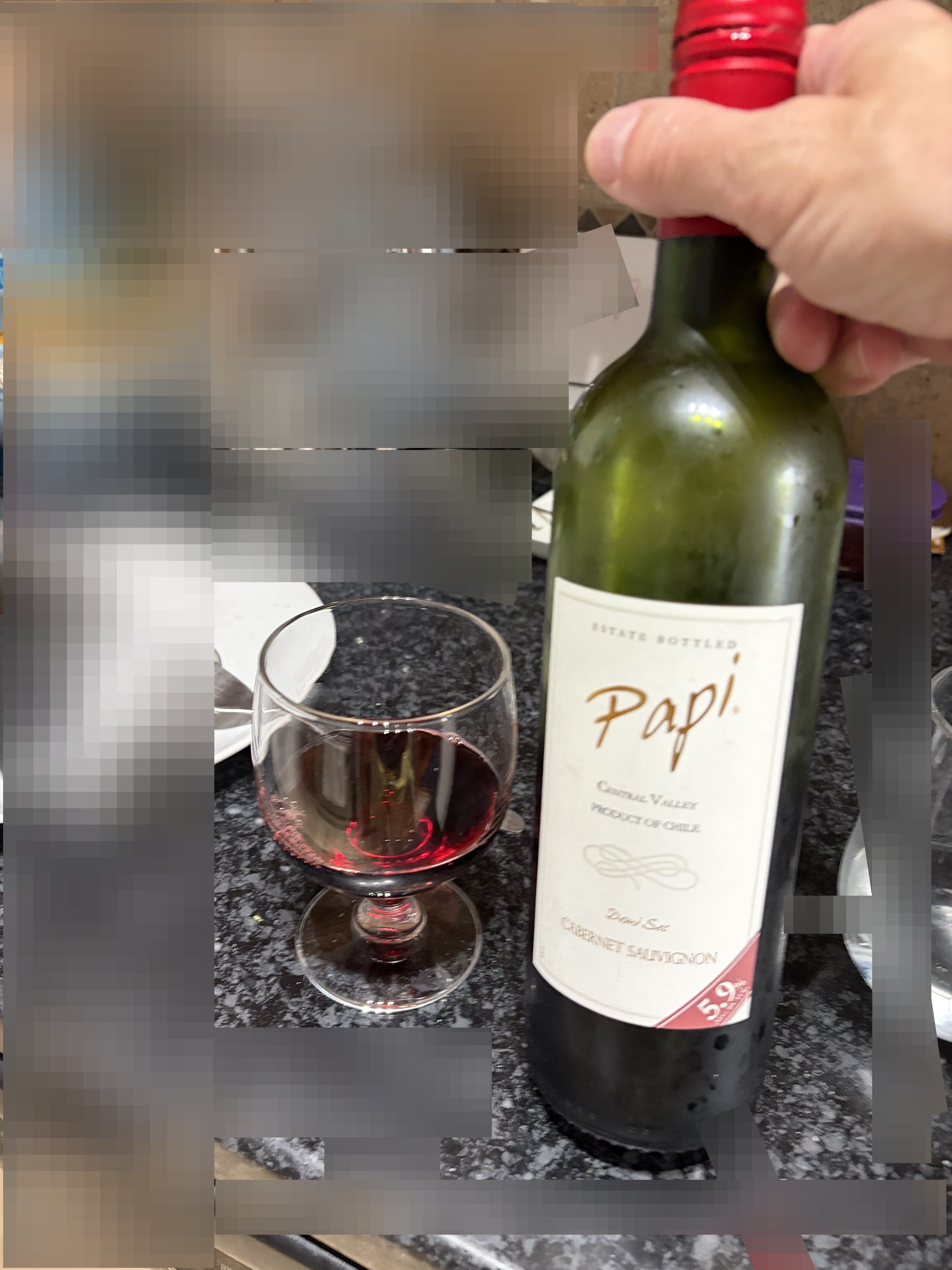
If you want to pick up something wine-esque to go with your fancifully named breakfast cereals, however, Trader Joe’s does offer what’s known in the biz as wine product, in the form of a few varietals of the brand Papi, readily snatchable from the store’s diabolically plotted impulse-buy aisles. To skirt NYS, Papi’s x TJ Cab Sauv Demi-Sec clocks in at a refreshing 5.9% alcohol level; however Papi watered down their standard 12% version (available by mail-order in a three-pack), they did it perfectly, with the elegance of the chemist who came up with the formula for Cherry Coke Zero.
I know almost nothing about Chilean wine; some might argue Papi is not the place to start. On the other hand, the Spigot ethos is a constant drive toward self-improvement. Why not learn while our tongue is lapping South America? Papi comes from Chile’s Central Valley, which has four regions, Maipo, Rapel, Curico, and Maule, divided in turn into subregions. Like California, the Americas’ other wine-growing capital, the climate resembles that of the Mediterranean, which has resulted in Chilean wine specializing in the cultivation of French styles and varietals. The country’s unique entry into the global taste market is Carménère, a grape that long-ago emigrated from Bordeaux but went essentially extinct in the Old World after the great phylloxera plague of 1867 (a tale I need to devote a column to someday). They kept making it in Chile, however, and it’s become the country’s signature, with a disconcerting note of green pepper.
As for Papi, all regional refinement is nugatory. For a brief instant after pouring, it tastes pretty good. Very brief however. It’s odd—the wine tastes like two incongruent things mixed together, fruit punch and antifreeze. Imagine a cheap bottle of red that you spilled into the bottom of a cooler then poured into a Big Gulp of Kirkland-brand Sprite. But that makes Papi sound less of a good time than it is. Demi-sec means off-dry which means I expected to be sipping syrup, but Papi Cab’s sugar level is not in fact crazy; it tasted no sweeter than countless other cheapo wines I’ve had. Is that a note of absinthe I detect deep in its fruity heart?
I can’t recommend any food pairings for Papi aside from milk chocolate bars, but if you put it in the fridge for twenty minutes, it’s a refreshing summer quaff. You get what you pay for. It could be 100 times worse. Maybe it’s nasty, but it’s definitely not gross. Enjoy Papi!
Was momentarily obsessed w/ a very nice incredibly cheap chilean carménère from TJ’s a few years back