
In Stitches
Alex Kwartler at Magenta Plains, del Toro's Frankenstein, and tasty Ukrainian Chardonnay
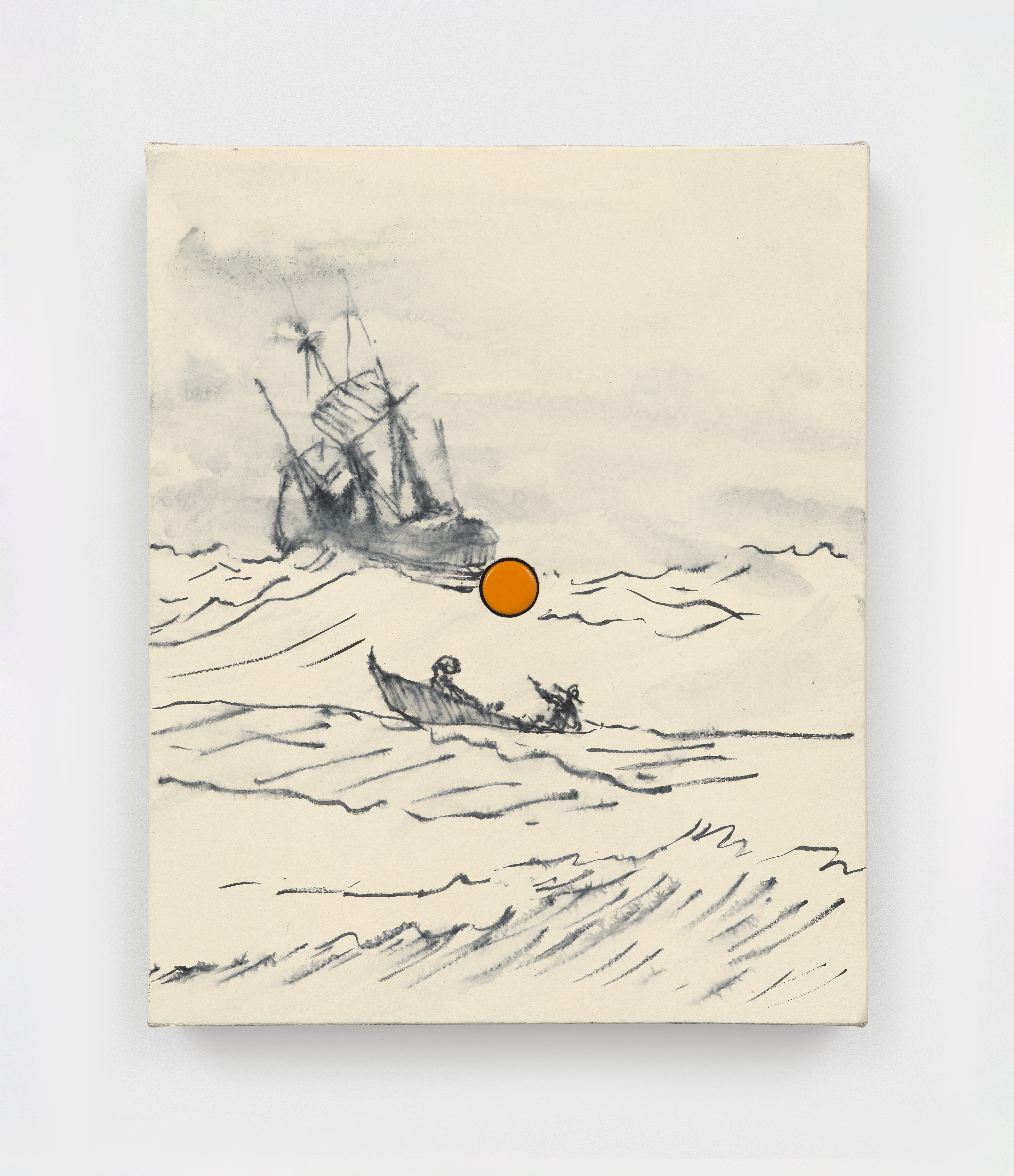
If you, a New Yorker, leave the house once this week, visit Off-Peak, Alex Kwartler’s new exhibition at Magenta Plains. I’m proud to have written an essay for the catalogue.
Kwartler’s paintings take the everyday as it is, viz., as the only access point we have for getting to the profound. If you want to get out of your head, you have to go through a tuna can. To quote the piece:
Kwartler has one series of paintings depicting the Earth from outer space, another depicting snowflakes at microscope range. He eschews gesture and index, those traces that declare that the painter once stood just there as close as you do, et in arcadia ego. Instead, he traffics in the index’s cousin, the icon, and in the cases of a couple specific items, he has made a hallmark of the object itself in a flicker of assemblage.
One of those objects-in-itself is in fact the tuna can. (I’m not clever enough to come up with that joke myself.) It’s a familiar motif in the artist’s recent work:
The tuna can is built into our daily lives as something dependable, practically eternal—an icon of the day-to-day, something you can never imagine not having been there nor ever going away. The suspension that the routine inhabits is where Kwartler’s imaginary dwells, sinking into both a sense of monotony and an appreciation of ongoingness. . . . If time can ever stretch into something that defies death, it’s in the moments when we’re opening a can of Chicken of the Sea.
It would be disingenuous of me to pretend I’m unbiased, but I would also would be lying if I told you it wasn’t an exceptional show.
Film
One of the many great things about my current habitat is Water’s Edge Cinema, which is run by the nonprofit Provincetown Film Society. It shows a pretty straightforward selection of first-run arthouse movies—a couple notches above, say, Alamo Drafthouse—while also hosting a summer film festival and various repertory series. At the end of the calendar year, they also host a brief “For Your Consideration” selection of gratis screenings aimed at an apparent academy and film-professional constituency. I’m not sure why Netflix, A24, et al. consider it worth their while, given that anyone sane in the demographic they’re chasing would be wintering in Palm Springs, not Ptown, but hey, you have to find the Marty Supreme voters where you can.
The For Your Consideration films are, surprisingly, open to the general public. Thus a civilian like myself could have attended free viewings of not only the aforementioned Marty but other flicks like The Testament of Ann Lee, which I hear is very good; the latest episode in Brendan Fraser’s debasing and doomed bid for respect, Rental Family; and (good luck) Song Sung Blue. I was hoping for The Mastermind, but what can you do.
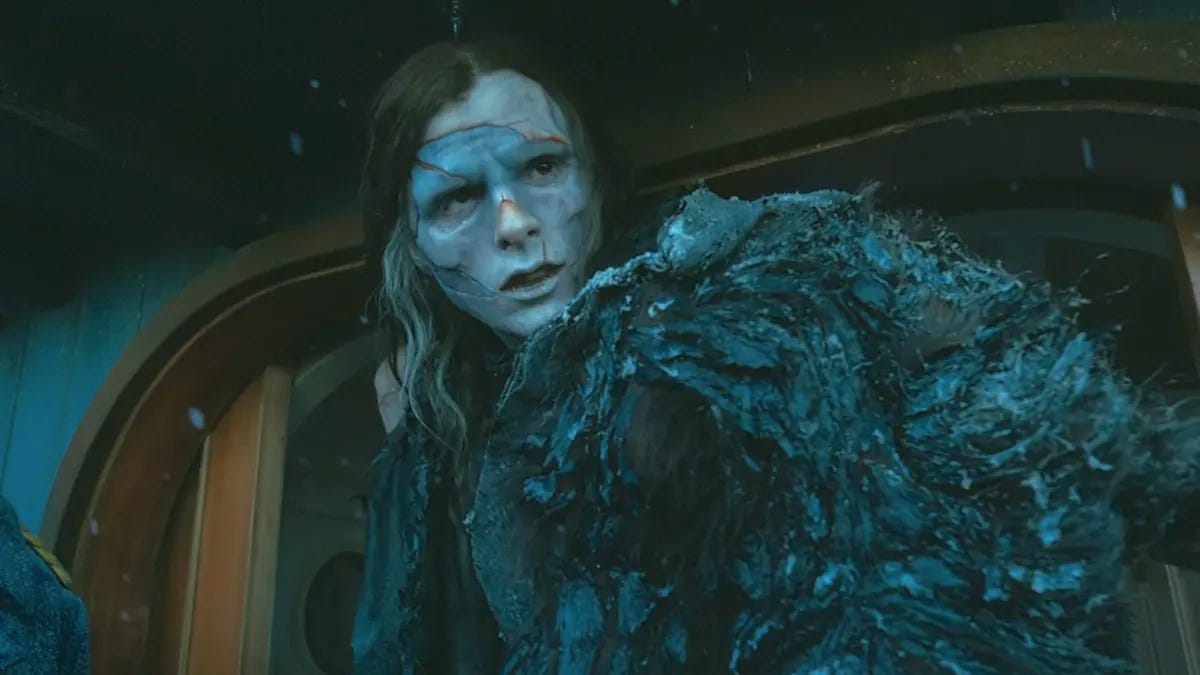
Because of the vagaries of my travel schedule, I managed to catch only one film, on New Year’s Day—Guillermo del Toro’s Frankenstein. I would never have paid for it, but it’s a fun watch (especially for free). I’m squeamish, but the practical-effects goo is less nauseating than the liberal humanist Shape of Water–style life lessons. The monster has feelings! He’s just like you and me.
Oscar Isaac plays the good (bad) doctor, who of course has to be ascribed some deep familial trauma as motivation instead of, in the book, a more sheerly Promethean ambition. Spoiler: Victor’s mom dies while pregnant with his little brother, who survives. Frankenstein blames his dad, an eminent surgeon, who conveniently kicks the bucket soon himself.
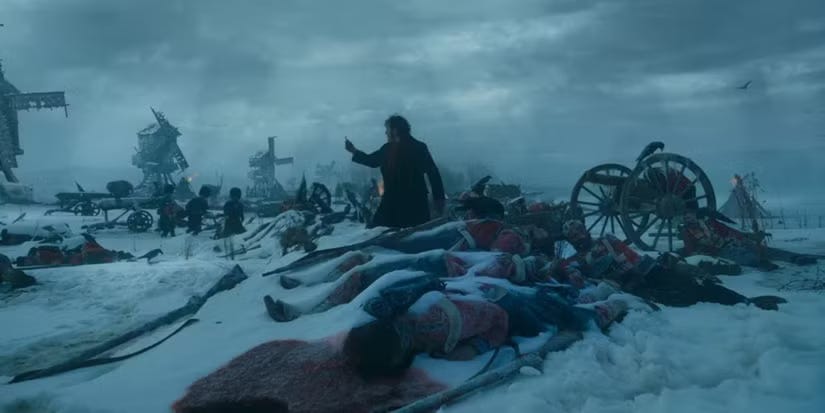
We then get to the fun part of the movie, which begins when the all-grown-up Frankenstein makes a deranged presentation of animated corpse parts to the Royal Academy of Medicine in London, meets his brother’s fiancé (played by Mia Goth) and immediately decides he needs to fuck her, and accepts a sinister offer to fund his ghastly endeavors from a mysterious arms merchant who happens to be the fiancé’s uncle. The scenes of Isaac visiting public hangings and the aftermath of what might be a scrambled allusion to the battle of Waterloo1 in search of hunks of handsome cadaver that might be reanimated are some of the only funny parts of the film and also the ones that best establish the doc’s psychotic zeal for what is underscored as an amoral, totally fucked-up project.
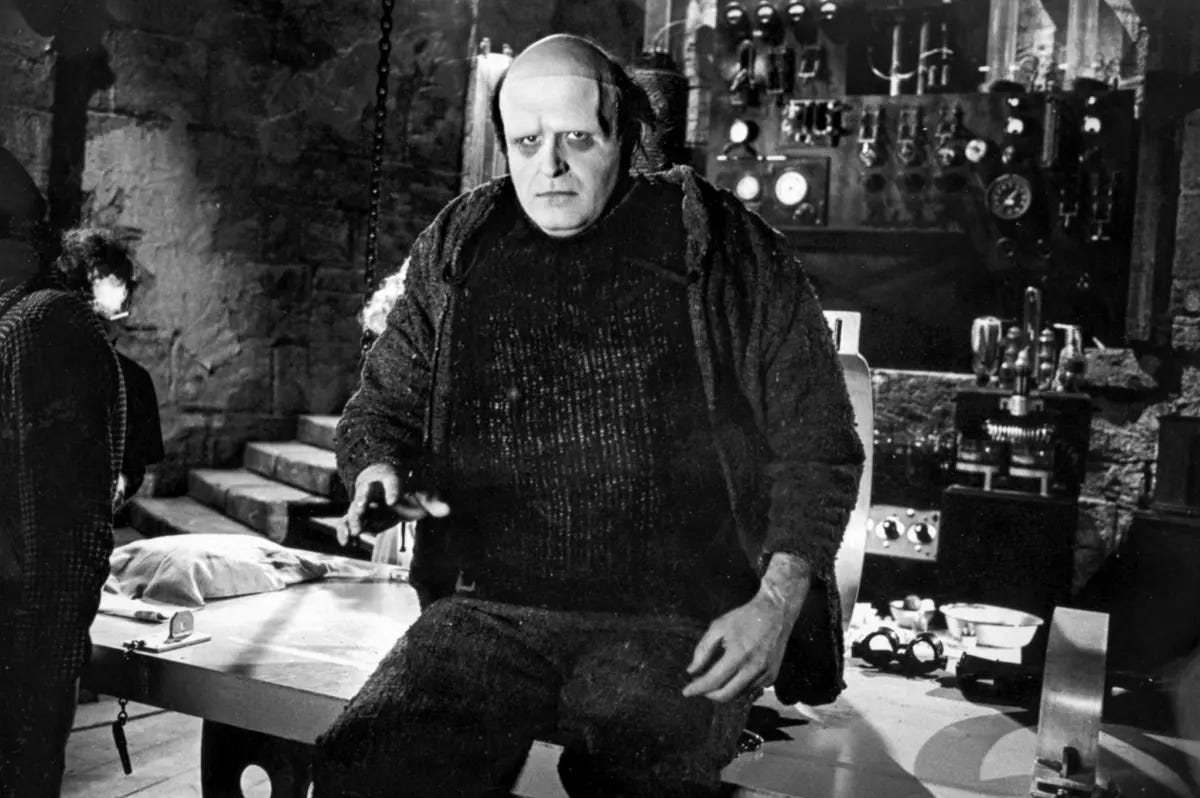
Then lightning strikes; the monster is given life. Has any Frankenstein’s monster been so hot? In fact yes: Srđan Zelenović in Paul Morrissey’s Warhol-produced Flesh for Frankenstein. But he was not nearly so elegant and well designed. The immaculately hairless body of Jacob Elordi, looking more powdered than pallid, is birthed bearing a irregularly beautiful netting of scar-lines in bruised and sanguine tones. Whoever conceived that tracery and the creature’s eventual costume, an elegantly ragged, patched-together cloak in muted tones, deserves some award-season hardware. Rick Owens might want to consider an infringement lawsuit, however, both for the garb and Elordi’s eventual jet black swoop of goth-boy hair.
As you may recall, del Toro isn’t a subtle director. Isaac frequently wears blood-red gloves. Goth’s plight as little more than chattel is visually proclaimed by a shot of her holding a captured butterfly in a lanternlike gilded cage, and she’s introduced to the viewer in an exquisite garb of blue-turquoise that features a horn-like feathered headdress: a treasured pet. (Otherwise the costumers have her giving John Everett Millais harder than Taylor as Ophelia.) And del Toro has her play not only the meat in a Frankenstein-brother sandwich but also, in the movie’s prologue, their mother! The most dazzling special effect in the entire enterprise is making Goth unrecognizable by the simple act of giving her eyebrows.
For all that, Frankenstein never becomes ridiculous. (Whether that’s a plus or a failing depends on you.) The actors chew the scenery only enough to produce a sturdy pulp. There’s less guts than anatomy, and the melodrama overheats but the engine never locks. The only moment where I wished they’d gone more camp occurs at the critical moment when the Creature, in search for his maker, comes across an envelope addressed to the doctor. With his recently acquired literacy (from a kindly old woodland blind man), we hear Elordi in voiceover pronounce the name “Victor Frankenstein” in classic Anglicized fashion, rather than Isaac’s continental style, either of which would have driven Gene Wilder to rage.
Wine
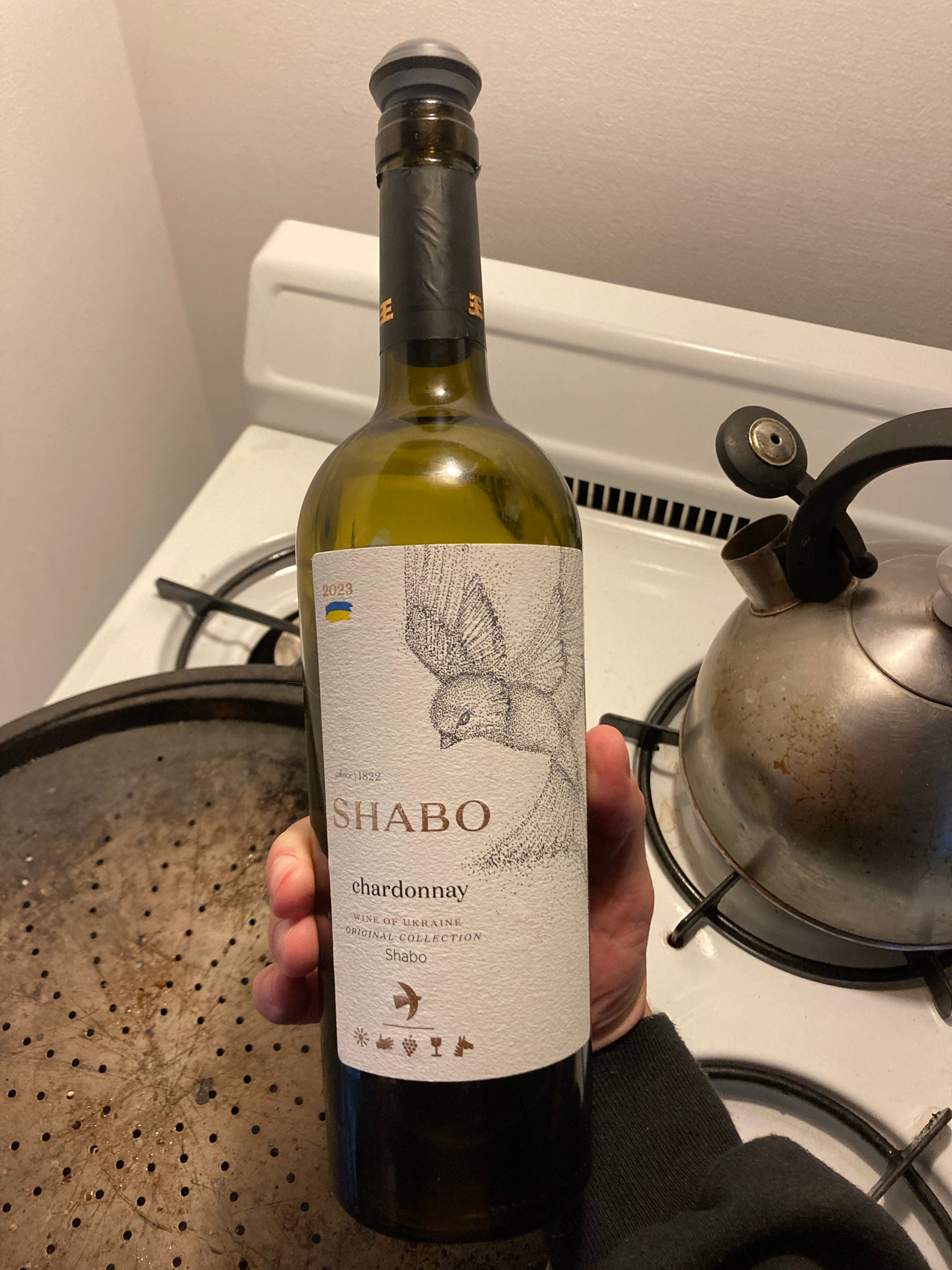
Shabo Chardonnay. You would think that my years stalking the liquor aisles of Ridgewood, QNS, and their stocks of various central and eastern European wines and spirits would have led me to already discover Shabo. But no: It was Mel at Perry’s Liquors in Provincetown. The Shabo winery is located in an eponymous town on an estuary in the far southwest of Ukraine, past Odesa toward Moldova. It’s alien territory for American drinkers, but wine has been made there for thousands of years, as it has in the more well-marketed Georgia across the Black Sea.
Modern production at Shabo was kickstarted, implausibly, by a contingent of some thirty Swiss from Vaud who moved there in 1822 on a land grant from Tsar Alexander I. (A historical society based in Switzerland maintains a charmingly rickety yet thorough website about the settlement replete with old drawings and paintings, newspaper clippings dating back a hundred years, videos and photos, and even archival documentation.) During the Soviet period, the town remained a major producer. The contemporary Shabo winery was founded in 2003, followed in 2009 by a wine cultural center featuring an appealingly strange fountain.
All that historical preamble leads to a happy conclusion: The wine itself, at least the Chardonnay I tasted, is really good. Retailing at $16.99, it’s also a genuinely great value.
Like Pinot Noir, Chardonnay has gotten a bad name thanks to (sigh) the United States and its syrupy, fruit-peelings-steeped-in-dirty-bathwater output. Shabo’s version isn’t a Côte de Beaune, but it’s better and cheaper than dare-I-say most Bourgogne Blancs you get in the US. It’s gentle and fresh in the vein of Chablis, with vanishingly little nose and a vegetally inflected flavor more like straw than grass or anything green; there’s also a tease of oak. After about 90 minutes the wine offers up a tinge of spice, and in another half hour or so it rounds out and gels fully but without losing its lowkey mineral sparkle. Cop Shabo wherever you can find it. I wouldn’t be shocked to see it on an LES menu for $15 a glass.
Music
One morning last week I turned on WOMR, Provincetown’s predictably eclectic independent radio station, and caught a cover of “To Know Him Is to Love Him” that sounded like a lighter, breathier Amy Winehouse. Turns out it was actually her. The 20th anniversary of Back to Black’s release isn’t until October; let this tide you over til then.
The film seems temporally and geographically elided. According to every source I’ve found, it takes place in the 1850s and features glass-plate photography. But Frankenstein lives in Britain and France, far from the scene of that era’s Crimean War. Clock the wrecked windmills looming in the background beyond the field of frozen corpses. The identification of Napoleon with the Antichrist ties in nicely with Frankenstein’s godless experiments, and Mary Shelley’s book was written in 1816. Yes, the weather is wrong for Waterloo, but hey, it’s a movie.
Eclectic mix, and engaging treat. Thank you.